An Autonomous Underwater Welding and Inspection ROV — DYUK'22 Paper
The ROV design we presented at Istanbul Gedik University's 1st National Congress on Interdisciplinary Approaches: doing underwater welding and weld inspection autonomously, in one vehicle, with image processing and machine learning.
In This Article
On 16–18 May 2022, at the 1st National Congress on Interdisciplinary Approaches (DYUK'22) — themed "Sustainable Future and Digital Transformation" and hosted by Istanbul Gedik University's Gedik Vocational School — we presented our paper Autonomous Underwater Welding and Underwater Weld Inspection Vehicle. It appears in the congress's official abstract book under ID 4449.
The work was co-authored by Kadir Gökhan Çalkap, myself, Hüseyin Kaygısız, and Erkin Duman, and carried out within the Machinery Program at Istanbul Gedik University.
The problem: the bottleneck is people, the cost is time
Underwater welding and weld inspection are critical but narrow fields for maritime logistics and the defence industry. Few technicians can do this work, and that scarcity turns directly into two costs:
- Wage cost — the supply of qualified diver-welders is limited, so each unit of work is expensive.
- Time cost — the process itself is long; every operation requires a dive preparation, descent, operation, and inspection cycle.
Every hour a ship or an oil pipeline spends waiting is a direct operational loss. The economic side of the problem, not the technical one, was the project's starting point.
The approach: welding and inspection in the same vehicle
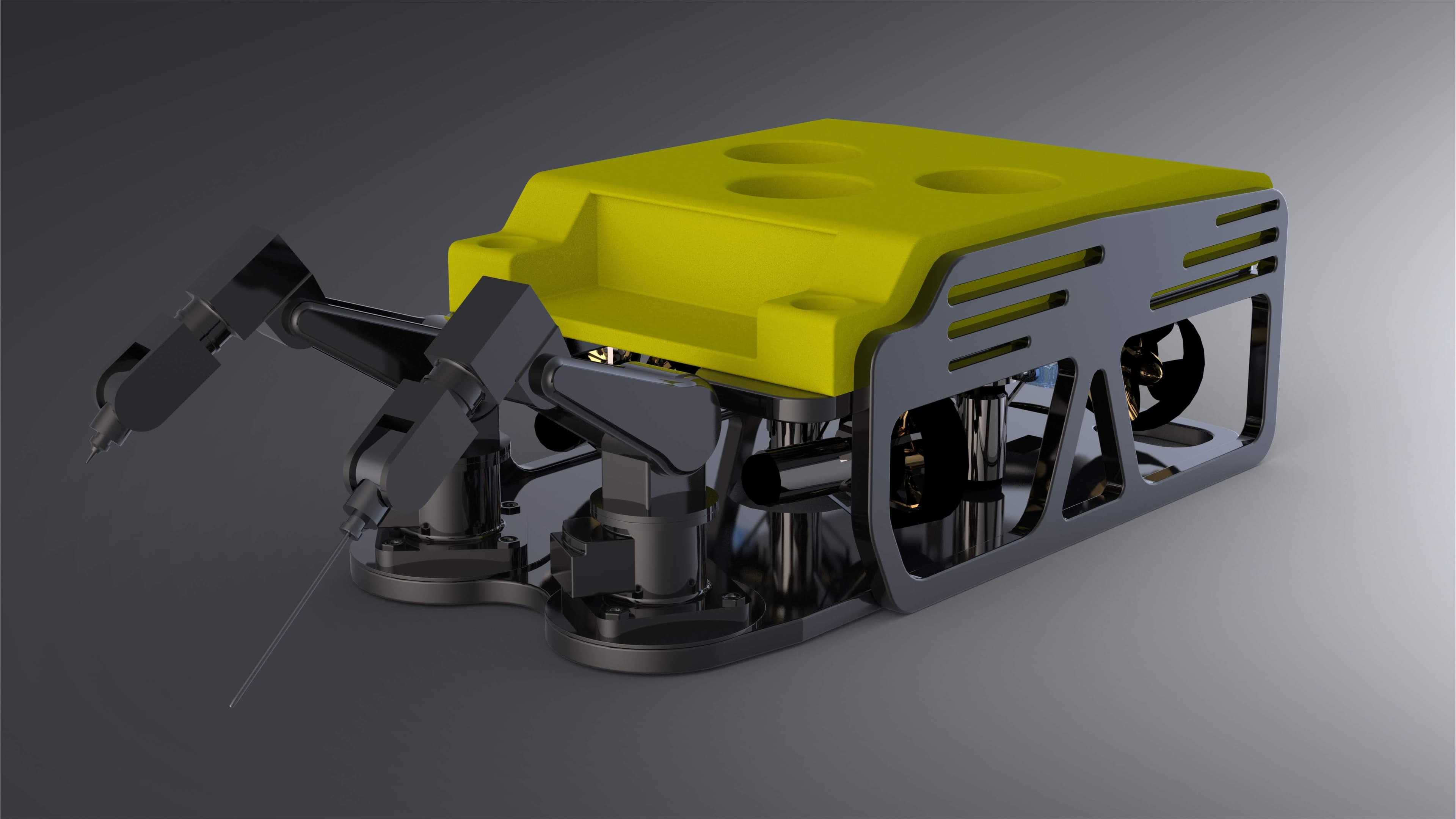
Our answer was an ROV (remotely operated underwater vehicle) able to perform underwater welding and weld inspection autonomously. The critical decision was to combine both operations on one platform rather than splitting them across two vehicles: if the vehicle that lays the weld can also measure its quality in place, no second dive is needed.
Two end units were added to the ROV for this:
- An underwater welding torch — the arm that performs the weld.
- An immersion probe — a second arm that carries out the weld inspection.
An onboard microcomputer coordinates and controls both units autonomously.
Hardware architecture
The component list from the paper is a good summary of why the vehicle is not "just a drone frame":
- Servo motors — control of the propellers (thrusters)
- Gyroscopes — balance and position calculation during welding
- Ultrasonic distance sensor — measuring the distance to the work area
- Camera module — identifying the region to be worked on
- Stepper motors — precise motion of the robotic arms
- Motor drivers — motor control
- Wireless communication modules — interaction with the operator panel above water
- Microcontroller — attaching and controlling the sensors
Holding balance with gyroscopes during welding is one of the most critical items on that list. A vehicle that cannot stay still under current will not lay an acceptable bead, however good the torch it carries.
The software side
Image processing and machine learning software were loaded onto the system so it could interact with the control panel and carry out its assigned task. Making sense of what the camera module sees, identifying the line to be welded, and evaluating the inspection result all belong to this layer.
Comparison: where we stand against a commercial ROV
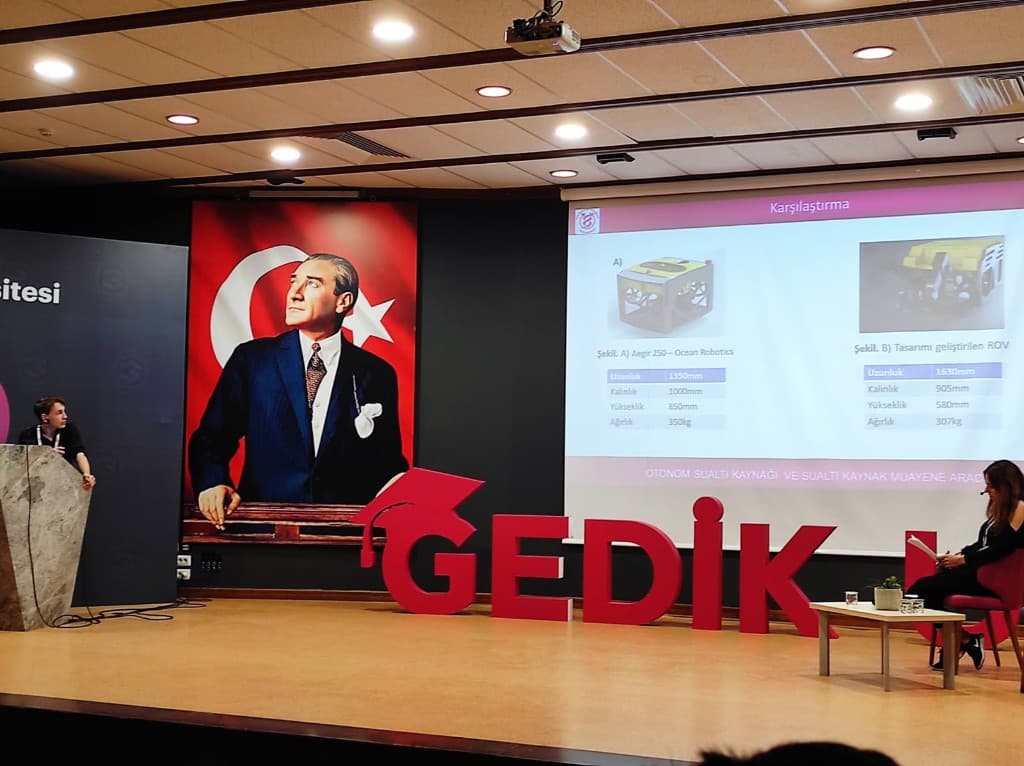
To keep the design grounded, we placed it side by side with a commercial reference — the Aegir 250 (Ocean Robotics). The comparison slide from the congress gave this table:
| Dimension | Aegir 250 (reference) | Our ROV |
|---|---|---|
| Length | 1350 mm | 1630 mm |
| Width | 1000 mm | 905 mm |
| Height | 850 mm | 580 mm |
| Weight | 350 kg | 307 kg |
The result reads clearly: our vehicle is longer than the reference but narrower, markedly lower, and 43 kg lighter. The low profile is a direct advantage for manoeuvring in tight openings such as ship hulls and pipelines; the weight difference shows up in transport and deployment cost.
Output and limits
The work completed the ROV design, examined the operating system, and produced a scale model. In other words, what we had was not a working field vehicle but a validated design and a physical model — there is no point in presenting it as more than that.
If the model were developed and turned into a product, the intended application areas were:
- Underwater pipelines used for oil transport
- Maintenance and repair of ships in maritime logistics
- Welding and inspection work in the defence industry where required
The goal was to make these operations fast, low-cost, and error-free.
Citation
The full abstract is published in the congress's official abstract book:
Çalkap, K. G., Seyrimez, M., Kaygısız, H., Duman, E. (2022). Autonomous Underwater Welding and Underwater Weld Inspection Vehicle (Paper ID 4449). Abstract Book of the 1st National Congress on Interdisciplinary Approaches, p. 35. Istanbul Gedik University, 16–18 May 2022.
The abstract book is available from the university's official site: dyuk.gedik.edu.tr — DYUK'22 Abstract Book (PDF)
Keywords: ROV (Remotely Operated Underwater Vehicle), underwater welding, underwater weld inspection, image processing, machine learning.